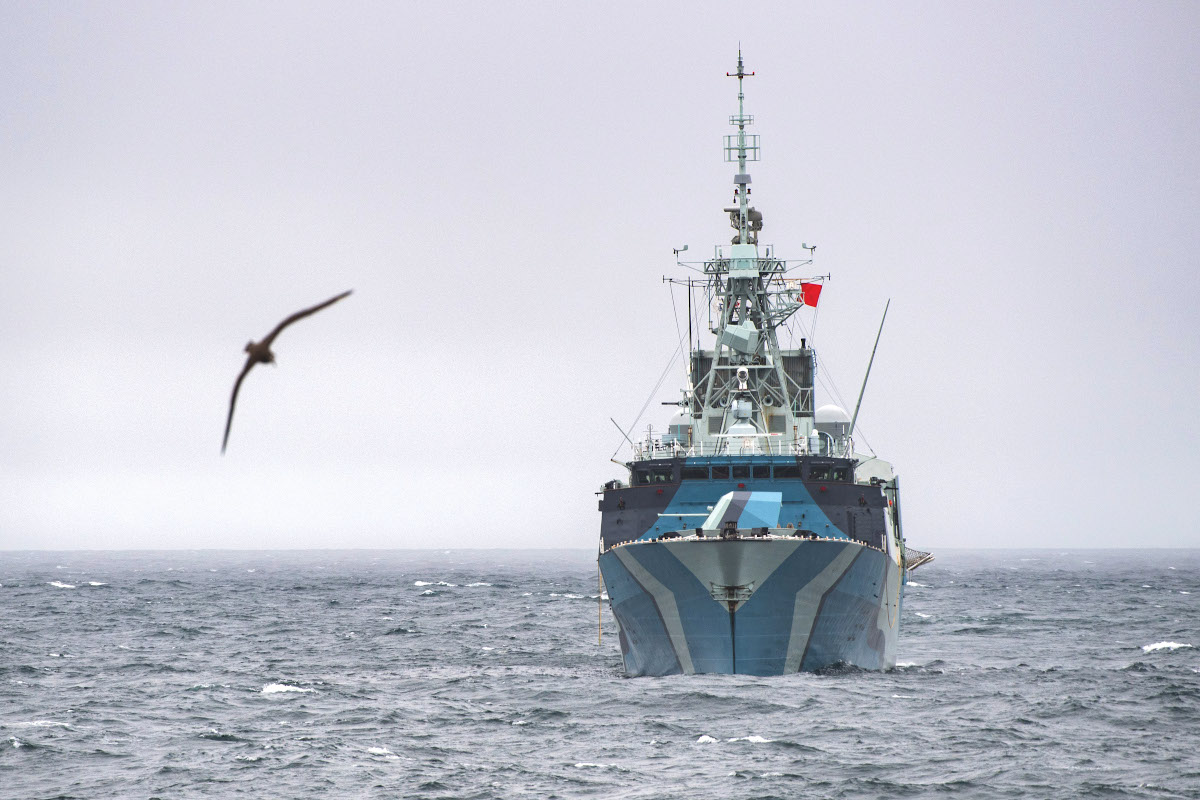
On February 24th, 2022, the Russian Federation launched its illegal invasion of Ukraine, raising alarms in the upper echelons of governments across the Western world.. In response to the invasion, NATO countries have increased defense budgets, accelerated procurement processes, and strengthened cooperation. Yet, one key NATO member—Canada—has been notably delinquent.
Canada has a long and storied military history. The victory at Vimy Ridge during the Great War was a turning point in our country’s history, symbolizing Canada’s emerging geopolitical and cultural independence from the United Kingdom. In the Second World War, Canada served as one of the major Allied powers fighting Nazi Germany, Italy, and Imperial Japan. By 1945, Canada had the fourth largest airforce and the third largest navy (second only to Britain and the United States).
Into the Cold War, Canada maintained a sizable armed force, participating in the Korean War as well as a variety of peacekeeping missions across the world. The Royal Canadian Air Force (RCAF) was, at least initially, supported by domestic manufacturing through Avro Canada’s CF-100 Canuck and maintained a state of high readiness and modernity into the 1980s. The Royal Canadian Navy also remained a global force, consisting of hundreds of surface vessels ranging from destroyers to light cruisers and included two aircraft carriers of which one served until 1970.
However, as the Cold War reached its conclusion, the federal government began to neglect the Canadian Armed Forces. Beginning under Prime Minister Pierre Trudeau, all three branches of the armed forces suffered a slow and painful decline in all facets of military readiness. Procurement times increased, equipment aged, training levels declined, and a variety of other key metrics of military readiness suffered. A “decade of darkness” in the 1990s saw the Canadian government cut even more off from defence spending, crippling the Canadian Armed Forces.
Today, Canadian equipment is aging, the process for the procurement of new equipment is one of the longest and most costly in the world, and Canada is now the only NATO country without a clear plan to meet its NATO commitment of spending 2% of GDP on defense. However, to understand the scale of Canada’s defence issues, we must look at each of the three branches independently.
Let’s begin with the Royal Canadian Navy. With the Northwest Passage beginning to emerge as a viable trade route, it is critical that the Royal Canadian Navy have the capability to defend its sovereignty over the Passage. At present, Russia, China, and the United States all have a keen interest in removing the route from Canada’s direct control (the U.S. doesn’t recognize the Northwest Passage as Canadian territory, even though it falls within Canadian territorial waters). The geopolitical dispute over the Northwest Passage has had significant implications for Canada’s defense policy. In the 1980s, Canada planned to build nuclear-powered submarines capable of patrolling the Passage and competing with those of major powers. However, the project was cancelled for a variety of reasons, with the United States vocally opposing Canada’s acquisition of such submarines. In their place, Canada acquired several used conventional submarines that were in a state of near disrepair and required extensive modernization and refit before being serviceable for the RCN (which, I might add, are still in service today). This has been the story of Canadian procurement; when we purchase equipment, it tends to be outdated and often requires large sums of money to bring to combat readiness; when we attempt to procure our own equipment, huge bureaucratic obstacles present themselves, substantially increasing costs, draining resources, and extending the time necessary to go from the planning stage to introduction into the forces.
Look at any recent RCN project and you’ll notice substantial delays, major cost overruns, old and underpowered equipment (and usually resulting in some of the least effective and most costly equipment of any NATO nation). The Harry DeWolfe-Class Offshore Patrol Vessel, which recently entered service with the RCN, provides some insight into the naval procurement process. With the Harry De-Wolfe-Class being based on the Norwegian Svalbard Offshore Patrol Vessel, one would expect the specifications and overall cost to be roughly the same. In reality, the Canadian vessel costs substantially more but travels approximately 0.5 knots slower, has half the helicopter-carrying capacity (one instead of two) and is less well-armed (a short range 25mm gun instead of a 57mm gun) when compared to its Norwegian counterpart. This is not to say that it is an ineffective ship or that Canadian shipbuilding is poor, but instead the Canadian procurement process often yields more weakly armed vessels at a higher cost (often by substantial amounts) when compared to competitor ships and a longer time for the full production run to enter into service. Another major RCN procurement project is that of the Canadian River-Class Destroyer, which will replace the Halifax-Class Frigates. The vessels will begin entering service with the RCN in the 2030s, but, if we assume that all 15 planned ships are constructed, the final vessel will not enter service until the 2050s—-nearly two and a half decades after the design was published. And with most other Canadian procurement programs, we can likely expect more delays, heightened costs, and cancellations if our process is not corrected soon.
The Royal Canadian Air Force has suffered from a similar fate. It currently operates a fleet of CF-18 multirole fighters that were introduced in 1982 and, much like the other pieces of Canadian equipment, are seeing heightened servicing costs and reduced combat readiness as age takes its toll on the jets. Under Prime Minister Stephen Harper, Canada was set to purchase enough F-35s—a 5th Generation stealth multirole aircraft that is considered one of the most effective aircraft on the market—to replace the aging fleet of CF-18s. However, after winning the 2015 federal election, Prime Minister Justin Trudeau cancelled the purchase without convincing justification only to decide once more to purchase the F-35s close to a decade later. During this time, the Canadian dollar dropped from practical parity with the US Dollar to 70 cents to the dollar and extended the delivery date to the 2030s. This means that when the first F-35 is delivered for the RCAF, the backbone of its force, the CF-18s, will be reaching five decades of service. Canadian procurement strikes again.
One service I have yet to discuss is the Canadian Army. The Canadian Army, like its counterparts, is in a woeful state. It has lacked air defense capabilities since 2012, and only recently replaced a pistol that had been in service since 1944. Many of its other key assets—including tanks, machine guns, and LAVs—are plagued by chronic mechanical breakdowns. In fact, close to half of the equipment in the Canadian Armed Forces is unserviceable. Unlike peer countries of similar size and need, Canada has a notable lack of self-propelled artillery, which allows for more mobile fire support for infantry in comparison to the more unwieldy artillery guns currently in use that require separate vehicles for transportation. The Canadian government does not appear to have any concrete plans to purchase any form of self-propelled artillery soon, while Australia, a country of roughly comparable size, is set to acquire 30 new state of the art AS9 self-propelled guns beginning this year. Canada simply is not meeting the modernization and capability of its allies. With continued ambivalence toward the Department of National Defence, there appears to be no hope, at least under this government, of recovery for several years.
There are several avenues that must be explored to increase the combat readiness of our armed forces, modernize its equipment, and drastically improve the procurement process. Firstly, Canada’s procurement process, as mentioned earlier, is one of the longest and most expensive of any NATO ally. Much of this comes down to unnecessary bureaucracy as plans move through the hierarchy. At the moment, both the DND and Public Service and Procurement Canada need to greenlight project spending. Cutting out the latter is a good start. Within the DND, streamlining both project requirements such that proposals don’t extend hundreds of pages (states of similar need and size often have proposals that can cap out at a dozen pages) and the process by which the civil service reviews procurement plans will aid in making more efficient our procurement process, while reducing unnecessary costs that Canada has historically been notorious for. As the Ukraine War has shown, procurement of equipment can take mere months if a government has the courage to do so. Canada also desperately needs to bolster its defence spending at-large and must develop a specific and realistic plan to reach defence spending equivalent to 2% of GDP. At present, we are not on track to spend 2% at all (which was a commitment we made to NATO in 2014 and have been delinquent on ever since).
There are a variety of other more specific approaches that need to be taken to redevelop the Canadian Armed Forces. We owe it to our allies who rely on Canadian military cooperation, to Canadians who depend on it to defend our sovereignty, and, most importantly, to the men and women of the Canadian Armed Forces who put their lives on the line and deserve equipment they can trust. At present, we are not fulfilling our obligations. We must soon.
 NATO YOUTH 🇨🇦
Leave a comment